Code
library(needs)
needs(igraph,
intergraph,
igraphdata)Welcome to this weeks session on social network analysis!
library(needs)
needs(igraph,
intergraph,
igraphdata)An actor’s membership in highly cohesive social groups has been considered in many sociological studies. It has been hypothesised to correlate with other aspects of social behaviour such as
In order to empirically test these sorts of hypotheses, groups must be detected in a network.
But what exactly is a highly cohesive social group?
In network analysis, a social group can be defined by the structure of the underlying network relations. This task of identifying these is called community detection. The development of methods for community detection has been — and continues to be — a highly active area of research Smith and Papachristos (2021).
We look for groups (or communities) in networks because individuals often cluster together due to homophily (tendency to associate with similar others) or shared social contexts and activities. These structural clusters often play a critical role in shaping behavior, diffusion of information, and social influence.
By a community ,” we typically mean a set of nodes with dense internal connections and relatively few ties to the rest of the network (Kolaczyk and Csárdi 2020). This contrasts with overly strict definitions like cliques and better reflects the loosely cohesive groupings common in empirical networks .
Take for examples this artificially constructed network:
# Create 3 groups with 10 nodes each
group_sizes <- c(20, 10, 10, 10)
num_groups <- length(group_sizes)
# Probability of connection
p_in <- 0.4 # high within-group connection probability
p_out <- 0.02 # low between-group connection probability
pref_matrix <- matrix(p_out,
nrow = num_groups,
ncol = num_groups)
diag(pref_matrix) <- p_in # within-group connections
# Generate the graph using stochastic block model
g <- sample_sbm(sum(group_sizes),
pref.matrix = pref_matrix,
block.sizes = group_sizes)
# Add group membership as vertex attribute
V(g)$group <- rep(1:num_groups,
times = group_sizes)
# Color nodes by group
group_colors <- c("lavender", "lavender", "lavender", "lavender")
V(g)$color <- group_colors[V(g)$group]
# Plot the graph
plot(g,
vertex.label = NA,
vertex.size = 10,
layout = layout_with_fr)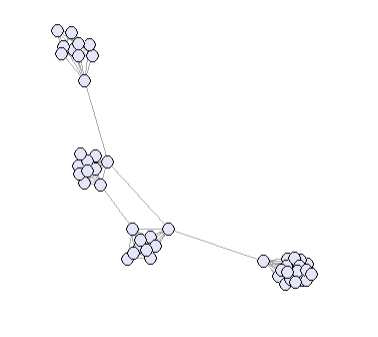
The detection is less trivial in most real networks.
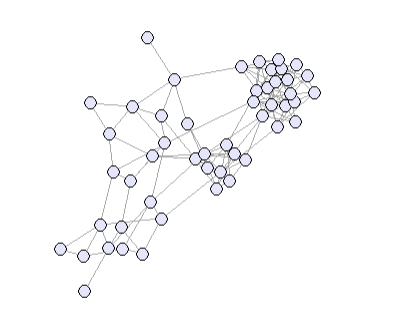
** Small world phenomenon**
In large scale contemporary societies, two randomly chosen individuals are personally connected, via their friends, acquaintances and family
A small-world network is thus a network that is characterized by
High clustering: your friends are also friends with each other.
Short average path lengths: most individuals are only a few steps away from one another.
Subgroups in networks are often defined by patterns of connectivity. These patterns help us identify tightly knit sets of actors that may share similar roles, resources, or behaviors.
One way to define network communities is by the level of connectivity. Recall that a network is completely connected if every pair of nodes is linked by a single edge.
triad <- make_full_graph(3) # Complete graph of 3 nodes (triad)
graph_4 <- make_full_graph(4) # Complete graph of 4 nodes
graph_5 <- make_full_graph(5) # Complete graph of 5 nodes
graph_6 <- make_full_graph(6) # Complete graph of 6 nodes
par(mfrow = c(1, 4))
# Plot each graph
plot(triad,
vertex.size = 20,
vertex.label = NA,
vertex.color = "lavender",
edge.color = "gray")
plot(graph_4,
vertex.size = 20,
vertex.label = NA,
vertex.color = "lavender",
edge.color = "gray")
plot(graph_5,
vertex.size = 20,
vertex.label = NA,
vertex.color = "lavender",
edge.color = "gray")
plot(graph_6,
vertex.size = 20,
vertex.label = NA,
vertex.color = "lavender",
edge.color = "gray")
par(mfrow = c(1, 1))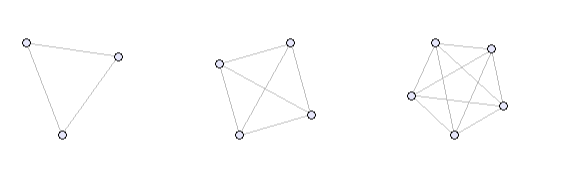
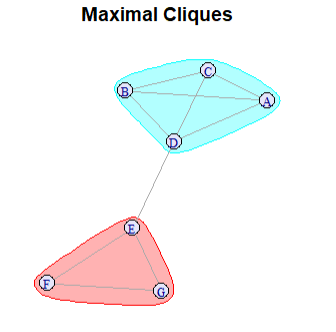
When applied to a subnetwork, such a structure is called a clique. A clique is maximal if no other actor can be added to it without breaking its complete connectivity. That is, every member is connected to every other, and no additional node outside the group is connected to all of them.
If you recall the triad-census from two weeks ago, a 3-clique is a triad 300 (Fuhse 2018).
For example, in the following network:
g <- graph_from_literal(A:B:C:D -- A:B:C:D, D - E, E - F - G - E)
plot(g,
layout = layout_with_fr,
vertex.label.cex = 0.8,
vertex.color = "lavender")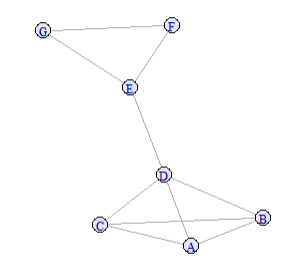
We can identify cliques and maximal cliques using:
cliques(g,
min = 3)
max_cliques(g,
min = 3)
count_max_cliques(g,
min = 3)
largest_cliques(g)
# Visualize maximal cliques
plot(g,
mark.groups = max_cliques(g, min=3),
vertex.label.cex = 0.8,
main = "Maximal Cliques",
vertex.color="lavender")
# Visualize cliques
plot(g,
mark.groups = cliques(g, min=3),
vertex.label.cex = 0.8,
main = "Cliques",
vertex.color="lavender")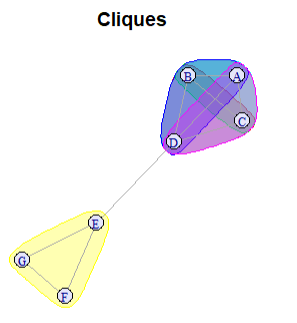
g <- graph_from_literal(1-2:3:4:5:6:7, 2-3:4:5:6:7, 3-4:5:6:7, 4-5:6:7,
5-6:7, 6-7, 7-8:9:10, 8-9:11,
11-12, 12-13:14, 9-10:13, 10-15,
14-16, 13-16, 15-16)
plot(g)min = 3 and highlight them visuallyplot(g,
mark.groups = max_cliques(g, min=3),
vertex.label.cex = 0.8,
main = "All maximal Cliques",
vertex.color="lavender")group.largest_clique <- largest_cliques(g)[[1]]
largest_clique <- max_cliques(g, min=4)[[1]]
V(g)$group <- V(g) %in% largest_cliqueLimitations of Cliques:
Cliques are one of the simplest and strictest forms of cohesive subgroups. However, they have several limitations:
Cliques are oftenly connected with each other and nodes and relations overlap. Because of this, there are several proposals for the relaxation of these concepts (Balasundaram, Butenko, and Hicks 2011). One method is the so called n-clique. To identify these, we do not only count direct relationships, but we look at cliques as the clique and all nodes that are reachable within a distance of \(n\). Usually we call for small \(n\)s like \(2\).
Exercise:
groupvariabledist_matrix <- distances(g, v = largest_clique)
dist <- apply(dist_matrix,
2,
min)
nodes <- which(dist <= 2)
V(g)$group[nodes] <- TRUE
V(g)$color <- ifelse(V(g)$group, "lavender", "lightblue")
plot(g)Another possibility to identify looser subgraphs are k-cores.
A k-core subgraph is a maximal subnetwork in which every node is connected to at least \(k\) other nodes within that subnetwork (Batagelj and Zaversnik 2003). The k-core of a graph is the maximal subgraph in which every vertex has at least degree k. The cores of a graph form layers: the (k+1)-core is always a subgraph of the k-core.
In igraph coreness() calculates the largest \(k\) (Coreness) for each node, so that this node belongs to this k-core.
coreness(g)The concept of k-plex looks for the largest group \(n\) inside a network where each person is allowed to not know up to \(k-1\) persons in the group. So, each person must have at least \(n-k\) friends within the group.
Example: In a 2-plex of 5 people, everyone must know at least three of the others.
I graph doesn’t have a built-in support for k-plexes.
We can write our own function using the concepts of cliques though.
all_cliques <- cliques(g, min = 4)
is_kplex <- function(graph, nodes, k) {
subg <- induced_subgraph(graph, nodes)
degs <- degree(subg)
n <- length(nodes)
all(degs >= (n - k))
}
k <- 2
kplexes <- Filter(function(nodes) is_kplex(g, nodes, k), all_cliques)
plot(g,
mark.groups = kplexes,
vertex.label.cex = 0.8,
main = "2-Plex",
vertex.color="lavender")Another widely used approach to dividing a network into communities is based on the idea that members of a social group are more strongly connected to each other than to the rest of the network.
One way to formalize this is through structural cohesion. According to Moody and White (2003), the cohesion of a subnetwork can be defined by the extent to which its connectedness depends on individual members. That is, the structural cohesion of a group is measured by the minimum number of nodes that must be removed to disconnect the group.
This concept corresponds to vertex-connectivity (denoted as \(k\)): A group’s cohesion is the minimum number of actors who, if removed, would disconnect the group.
Moody and White proposed using this concept to divide a network into cohesive blocks — nested groups of actors that remain connected even as nodes are progressively removed.
“For a given graph g, a subset of its vertices h is said to be maximally k-cohesive if there is no superset of h with vertex connectivity greater than or equal to k”. Cohesive blocks are the maximally k-cohesive subnetworks.
In igraph we can find cohesive blocks via the call cohesive_blocks(). Through the graphs_from_cohesive_blocksgraphs_from_cohesive_blocks-function we can save these blocks as graphs. cohesion will give us the \(k\) score of each block. And max_cohesion()the maximal cohesion of each vertex.
However, the calculation of cohesive blocks is only efficient for small graphs (n < 100)
b <- cohesive_blocks(g)
length(b) # number of cohesive blocks
blocks(b) # blocks as vectors
graphs_from_cohesive_blocks(b, g) # blocks as graphs
cohesion(b) # the cohesion of the blocks
max_cohesion(b) # the maximal cohesion of each vertexExercise:
“If your method doesn’t work on this network, then go home.”
– Eric Kolaczyk, at the opening workshop of the 2010-11 SAMSI program year on Complex Networks on the karate network
Zachary (1977) studied conflict and fission in this network, as the karate club was split into two separate clubs, after long disputes between two factions of the club, one led by John A., the other by Mr. Hi. The Faction vertex attribute gives the faction memberships of the actors. After the split of the club, club members chose their new clubs based on their factions, except actor no. 9, who was in John A.’s faction but chose Mr. Hi’s club.
Because the Karate-network from Zachary includes a real-life slpit, it gives a ground thruth to compare the algoritmic results.
igraphdata packagedata(karate)
plot(karate)
karate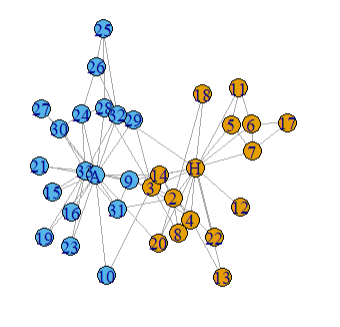
largest_clique <- largest_cliques(karate)
sapply(largest_cliques, length)
V(karate)$group_clique <- V(karate) %in% largest_clique
table(
Clique = V(g)$group_clique,
Truth = V(g)$truth
)2.1 How well do they perform in reference to the ground truth?
2.2 What insight does each method provide?
Although the general principle behind community detection is relatively straightforward - to identify those vertices that are more closely tied to each other than to others in the network - finding communities can be computationally very demanding - especially for large networks. Nevertheless, many algorithms have been developed and igraph contains several of them. With your own data you should try using different ones to determine which appears to be the most useful as they all have different strengths and weaknesses. In this section, you will use two different methods - the fast-greedy method and the edge-betweeness method.
One intuitive way to identify communities is to find and remove the “bridges” between groups. These are the edges that lie on many shortest paths — in other words, they have high edge betweenness.
Edge betweenness is defined similarly to vertex betweenness:
Let
- \(( g_{jk} )\) be the number of shortest paths between nodes \(( j )\) and \(( k )\),
- \(( g_{jk}(e) )\) the number of those paths that pass through edge \(( e )\).
Then the edge betweenness \(( B(e) )\) is:
\[ B(e) = \sum_{j < k} \frac{g_{jk}(e)}{g_{jk}} \]
This metric helps identify key connectors in a network whose removal will fragment the graph.
edge_betweenness(karate)
E(g)$betw <- edge_betweenness(karate)
plot(g,
vertex.color = "lavender",
edge.label = E(karate)$betw ,
edge.color = "gray",
main = "Network with Edge Betweenness",
vertex.size = 10, # Set a reasonable node size
vertex.label = NA, # Hide node labels (optional),
layout = layout_nicely(karate)
)
This algorithm uses edge betweenness to divide the network:
Although intuitive and sociologically grounded, this method is computationally expensive for large networks.
eb <- cluster_edge_betweenness(karate)
# Number of communities found
length(eb)
# Community structure
communities(eb)
membership(eb)
# Visualize communities
plot(karate, mark.groups = communities(eb), main = "Girvan–Newman Communities")Modularity is a quality measure for a particular division of a network into communities. It quantifies how well the division captures dense internal connections and sparse external ones. In other words the modularity score is an index of how inter-connected edges are within versus between communities.
Values of modularity range from −0.5 to 1, with higher values indicating clearer group structure. Values above ~0.3 usually indicate meaningful structure.
Modularity can also be used descriptively — for example, to assess how well a node attribute (e.g., gender, location) explains community divisions.
Fast-greedy is a modularity based method - it works by trying to build larger and larger communities by adding vertices to each community one by one and assessing a modularity score at each step.
Greedy: The algorithm is greedy because it always tries to make the best local decision at each step — merging the communities that will immediately improve the network’s structure.
Fast: It’s fast because it doesn’t have to check every possible community; it only considers the best possible merges, making the process quick.
In igraph, a relatively fast greedy algorithm is implemented that searches over all possible partitions and optimises the modularity in form of an agglomerative hierarchical clustering (Clauset, Newman, and Moore 2004)
fgc <-cluster_fast_greedy(karate)
modularity(fgc)
membership(fgc)
plot(fgc, karate, main = "Fast Greedy Communities")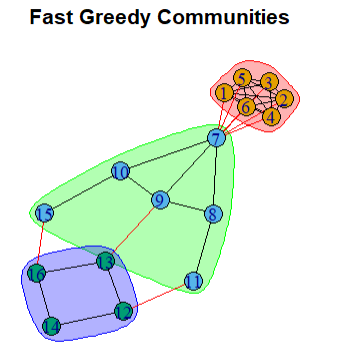
The Louvain method is widely used for large networks.
It starts by trying to maximize the \(Q^t\) value (modularity). It reaches its peak when three conditions are met:
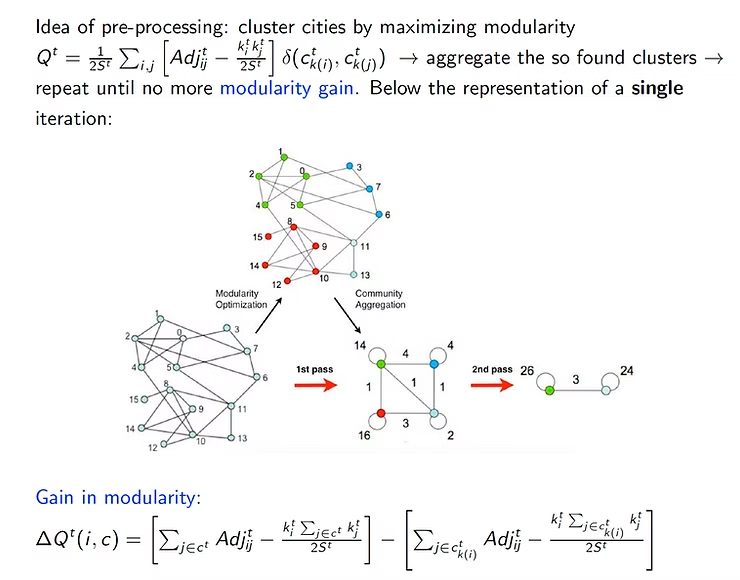
The louvain clustering algorithm
We keep doing this until we can’t improve the modularity any further – in other words, until our clusters are as meaningful and well-defined as they can be.
This iterative process of clustering, creating big nodes, and then re-clustering allows the Louvain algorithm to efficiently and effectively reveal the underlying structure of complex networks.
lv <- cluster_louvain(g)
modularity(lv)
plot(lv, g, main = "Louvain Communities")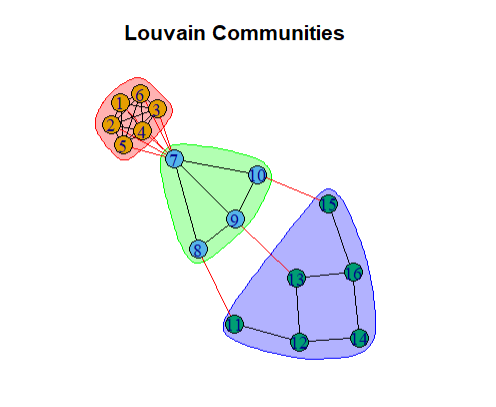
Pros:
Cons:
The Leiden algorithm improves Louvain by fixing some of its flaws (e.g., disconnected subcommunities). It guarantees well-connected communities and higher modularity while being fixer and more consistent as the Louvain.
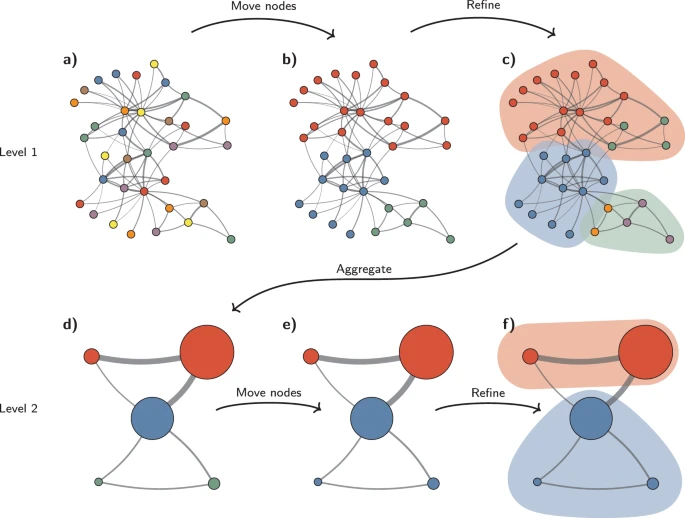
These steps are repeated until no further improvements can be made.
lc <- cluster_leiden(g,
objective_function = "modularity",
n_iterations = 10)
#modularity
communities(lc)
membership(lc)
plot(lc, g, main = "Leiden Communities")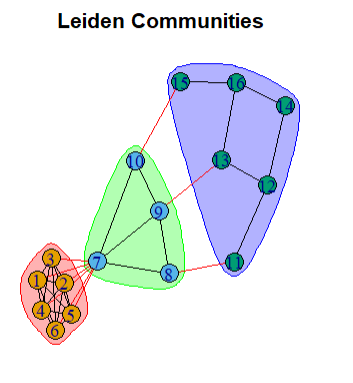
igraph| Name | Function | Directed Ties | Weights | More Components |
|---|---|---|---|---|
| Edge-betweenness | cluster_edge_betweenness |
✅ | ✅ | ✅ |
| Leading eigenvector | cluster_leading_eigen |
❌ | ❌ | ✅ |
| Fast-greedy | cluster_fast_greedy |
❌ | ✅ | ✅ |
| Louvain | cluster_louvain |
❌ | ✅ | ✅ |
| Walktrap | cluster_walktrap |
❌ | ✅ | ❌ |
| Label propagation | cluster_label_prop |
❌ | ✅ | ❌ |
| InfoMAP | cluster_infomap |
✅ | ✅ | ✅ |
| Spinglass | cluster_spinglass |
❌ | ✅ | ❌ |
| Optimal | cluster_optimal |
❌ | ✅ | ✅ |
Each community detection function produces several pieces of information in a community object. Using the functions length(), sizes() and membership() it is possible to quickly extract information about how many communities there are and which vertices are in which community. In igraph, it is also possible to make quick plots of the network which show each vertex in its community by color. To do this, the community object and graph object are included as the two arguments to the plot function.
The problem of validating a network partitioning is not trivial. If a vertex attribute is suspected to correlate with the clustering, it can be used to validate the clustring.
Exercise:
lc <- cluster_leiden(karate,
objective_function = "modularity",
n_iterations = 10)
plot(lc, karate)
cl <- cluster_leiden(karate,
objective_function = "modularity",
n_iterations = 10)
plot(cl, karate)
cfg <- cluster_fast_greedy(karate)
plot(cfg, karate)
plot(structure(list(membership=cutat(cfg,2)),class="communities"),karate)Over the past weeks, we’ve spent time creating, analyzing, and visualizing networks.
But so far, our approach has been purely descriptive.
Descriptive analysis helps us summarize network structures, such as:
However, we typically analyze just one network.
So — when we observe a measure — how do we know if it’s large or small? Without a sampling model or assumptions about randomness, we can’t:
This means we can’t tell whether a pattern is surprising or meaningful. Descriptive tools are limited in assessing these questions.
To go beyond description, we need models that let us answer research-level questions like
library(needs)
needs(RSiena,
statnet,
igraph,
tidyr,
igraphdata,
dplyr,
intergraph)
set.seed(1)In this approach, we generate random networks that preserve some basic properties—such as the number of nodes and ties, or the degree sequence—but are otherwise random.
Common examples include:
By simulating these graphs, we can generate a baseline distribution for network statistics and compare the observed network to this distribution.
The Erdős-Rényi model (1959) is the most basic random graph model.
Because edges are assigned independently, some values (like clustering and path length) can be calculated analytically.
Expected number of edges: \(\frac{n(n-1)}{2}p\)
Expected degree of a node:\((n-1)p\)
Expected clustering coefficient: \(\frac{\binom{n}{3}p^3}{\binom{n}{2}p} = p\)
In R, null-model comparison is as easy as using sample_gnm() or permuting edges.
In practice, when we compare real-world networks to Erdős-Rényi models with the same number of nodes and edges, we often observe:
data(karate)
#create erdos renyi graph
rand <- sample_gnm(vcount(karate),
ecount(karate),
directed = FALSE,
loops = FALSE)
par(mfrow=c(1,2))
# Degree distribution of observed network
degree_karate <- table(igraph::degree(karate))
barplot(degree_karate, main = "Karate Club", xlab = "Degree", ylab = "Frequency")
# Degree distribution of random network
degree_rand <- table(igraph::degree(rand))
barplot(degree_rand, main = "Erdős-Rényi", xlab = "Degree", ylab = "Frequency")
obs <- transitivity(karate)
rand <- transitivity(rand)
sim_trans <- replicate(100, {
gr <- sample_gnm(vcount(karate), ecount(karate))
transitivity(gr)
})
cat("Observed clustering:", round(obs,3),
"Mean(random):", round(mean(sim_trans),3),
"SD(random):", round(sd(sim_trans),3), "\n") Observed clustering: 0.256 Mean(random): 0.132 SD(random): 0.027
Obviously, what we see is that the observed clustering coefficient is substantially higher than the simulated average, it suggests a non-random structure — possibly reflecting social tendencies like triadic closure or community formation. But do we win any more information from this? At least we didn’t expect ties to form at random to begin with..
Real-world networks often display something that we call power-law degree distributions: many nodes have few connections, and a few nodes act as hubs with many connections (barabasiEmergenceScalingRandom1999a?).
These networks are known as scale-free networks because their degree distribution follows a power-law — it looks the same regardless of the scale at which we examine it.
# Set parameters
# Define parameters
alpha <- 1.1 # Power law exponent
C <- 8 # Constant multiplier
x <- seq(1, 100, length.out = 500) # x values
# Power law function
y <- C * x^(-alpha)
# Plot the line
plot(x, y,
type = "l", # Line plot
col = "lavender", # Lavender color
lwd = 4, # Line width
xaxt = "n", # Suppress x-axis ticks
yaxt = "n", # Suppress y-axis ticks
xlab = "number of ties",
ylab = "number of vertices")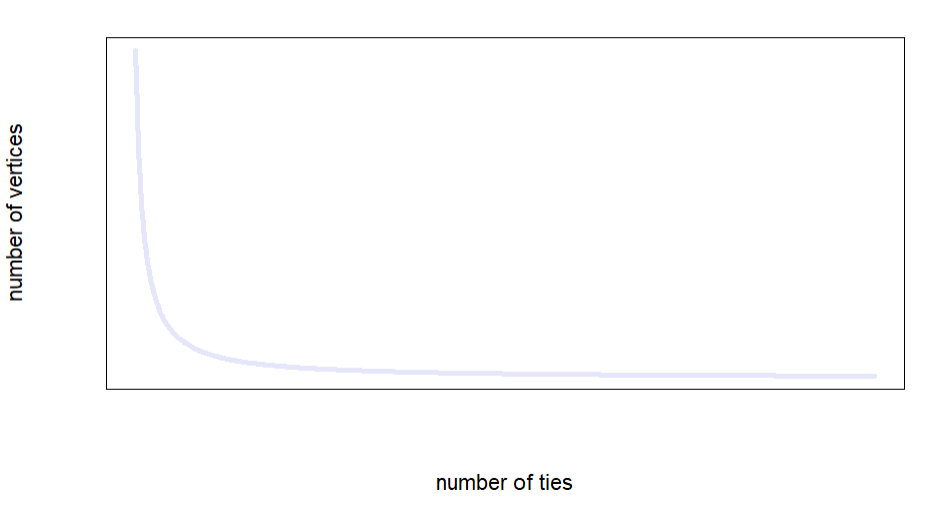
The “rich-get-richer” mechanism explains how hubs form in scale-free networks. Hubs are especially common in citation networks, biological systems, and technological networks, but not typically found in friendship or social networks, where humans have cognitive and temporal limits on the number of relationships they can maintain (Fuhse 2018).
To simulate scale-free networks, Barabási and Albert introduced a preferential attachment model for network growth. It starts with a small connected graph (e.g. two nodes with one edge) and then at each time step we add one more node and connect that node to an existing node \(i\) with probability:
\[\text{Prob(node i is chosen)}= \frac{deg(i)}{\sum_j deg(j)}\] This means nodes with higher degree are more likely to receive new edges, reinforcing hub formation.
The resulting degree distribution approximates a power law with expontne \(\gamma\) = 3.
# Define number of vertices and edges
n <- vcount(karate) # Number of vertices
total_edges <- ecount(karate)
m <- floor(total_edges / n) # Approx. number of edges per node
# Generate preferential attachment graph
pa <- sample_pa(n = n,
m = m,
power = 2,
directed = FALSE)
plot(pa,
vertex.color = "lavender")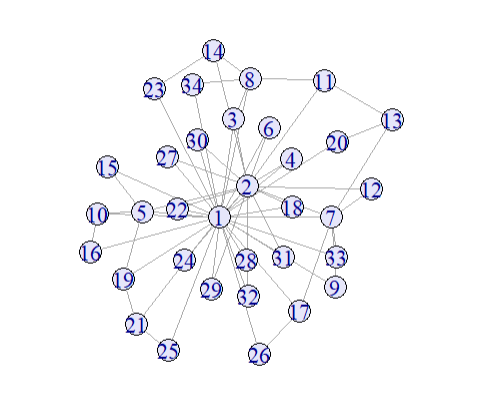
However, this simple process does not produce clustering (i.e., no triangles).
Exponential Random Graph Models (ERGMs) are a powerful framework for modeling the structure of a single observed network. They allow us to quantify which types of configurations are statistically more or less likely than expected by chance.
Formally, an ERGM models the probability of observing a network \(y\) as:
\[ P_\theta(Y = y) = \frac{\exp(\theta^\top g(y))}{k(\theta)} \]
Where: - \(g(y)\) is a vector of network statistics (e.g., number of edges, triangles, degree counts), - \(\theta\) are model parameters, - \(k(\theta)\) is the normalizing constant (summing over all possible networks with the same node set).
ERGMs are especially useful when we want to go beyond descriptive statistics and understand what social processes might be generating the observed structure.
statnetThe statnet suite provides a powerful set of tools for:
Following the ergm-tutorial of Chen (- Chen n.d.), We’ll use the flomarriage dataset: a historical network of marriage alliances among powerful families in Renaissance Florence .
library(ergm)
data(package="ergm")
data(florentine)
class(flomarriage) #statnet networks are objects of class "network"
flomarriage
summary(flomarriage)
plot(flomarriage)
#Provide the statistics of the network
summary(flomarriage~edges+triangle)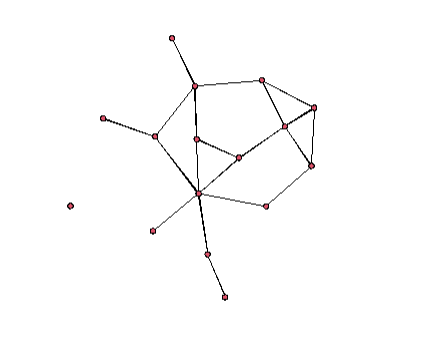
We can specify the network statistics \(g(y)\) to functions in the ergm package using the terms.
Most common terms are:
| Name | Unit of Counting | Description | Num. of Statistics | Dep/Ind | Dir/Undir | Unip/Bip |
|---|---|---|---|---|---|---|
| edges | edges | Number of edges | 1 | ind | both | both |
| nodefactor | units of the attribute | Times nodes with a categorical attribute level appear in the edge set | 1 per level | ind | both | both |
| nodematch | edges | Edges where incident nodes match on a nodal attribute | 1 or per level | ind | both | both |
| nodemix | edges | Edges between combinations of nodal attribute values | 1 per combination | ind | both | both |
| nodecov | units of the attribute | Sum of nodal attribute values for incident nodes across all edges | 1 | ind | both | both |
| absdiff | units of the attribute | Absolute difference in a nodal attribute between incident nodes | 1 | ind | both | both |
| mutual | dyad | Number of mutual edges (a → b and b → a) | 1 | dep | dir | both |
| degree | node | Number of nodes with degree x | 1 per degree value | dep | undir | unip |
| idegree | node | Number of nodes with in-degree x | 1 per degree value | dep | dir | unip |
| odegree | node | Number of nodes with out-degree x | 1 per degree value | dep | dir | unip |
| b1degree | node | Number of mode 1 nodes with degree x | 1 per degree value | dep | undir | bip |
| b2degree | node | Number of mode 2 nodes with degree x | 1 per degree value | dep | undir | bip |
| mindegree | node | Number of nodes with at least degree x | 1 per degree value | dep | undir | unip |
| triangles | triangles | Number of triangles | 1 (more if attributes used) | dep | undir | unip |
| gwesp | complex | Geometrically weighted edgewise shared partners | 1 | dep | both | unip |
For full list, in R type: help("ergm-terms")
When fitting an ergm we can think of ergm(y~x) as analogous to glm(y~x) - but for networks.
So these statistics make uup the \(g(y)\)-vector.
For example:
summary(flomarriage ~ edges + triangle + kstar(1:3) + degree(0:5))edges: overall density
triangle: tendency toward triadic closure
kstar(1:3): centralization / popularity (2-stars, 3-stars, etc.)
degree(0:5): distribution of node degrees
We can start by fitting the most simple ergm (with only the edges term). This is similar to comparing networks to the Erdos-Renyi graphl, assuming there is no structure beyond density.
$$
T(G) = #edges, = log
$$
flomodel.01 <- ergm(flomarriage ~ edges)
# View model summary
summary(flomodel.01)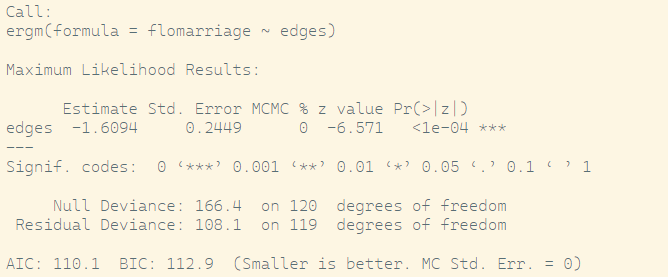
The interpretation is similiar to when you interpret glm:
edges Coefficient: If the coefficient is -1.6094, then: If the number of edges increase 1, the log-odds of an edge existing between any two nodes is -1.6094 -The probability of a tie between any two nodes is approximately 16.6%.
\(p< \alpha\): parameter does not equal to 0 significantly,
Null Deviance: The null deviance in the ergm output appears to be based on an Erdos-Renyi random graph with p = 0.5.
Residual Deviance: 2 times difference of loglik (saturated model - our model) (smaller is better)
AIC, BIC: loglik+penalty(#parameter)
triangle terms as a measure of clustering:flomodel.02=ergm(flomarriage~edges+triangle)
summary(flomodel.02)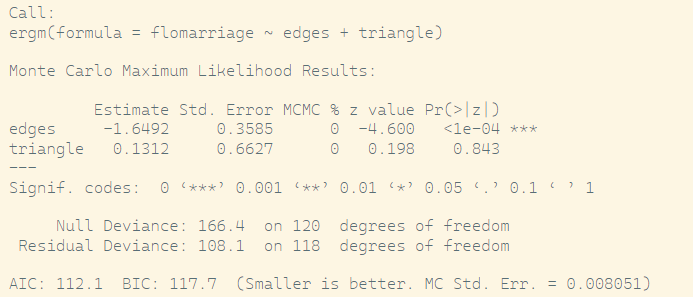
We can include continuous nodal covariates
wealth=flomarriage %v% 'wealth' # %v% get the vertex attributes
plot(flomarriage, vertex.cex=wealth/25, main="Florentine marriage by wealth", cex.main=0.8)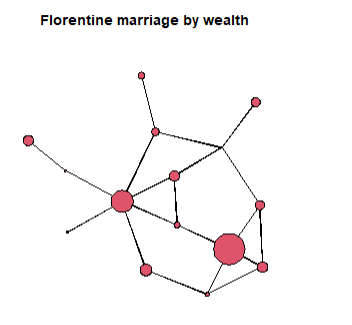
flomodel.03=ergm(flomarriage~edges+nodecov('wealth'))
summary(flomodel.03)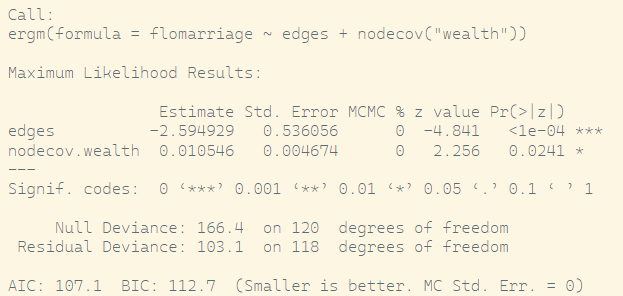
Baseline (edges):
The log-odds of a tie between two nodes with zero wealth is −2.595. This corresponds to a low baseline probability of a tie:
\[ \text{logit}^{-1}(-2.595) \approx 0.0695 \]
→ So, with no wealth effect, there’s about a 7% chance of a tie forming.
Wealth effect:
For each unit increase in wealth, the log-odds of a tie increase by 0.01055, per node. So:
\[ 2 \cdot 0.01055 = 0.0211 \]
In probability terms, this is a small but positive effect:
→ Richer nodes are more likely to form ties, and the effect is additive across node pairs.
Effect of absolute wealth difference: Specifically, it says:
“Are families with similar wealth more likely to form marriage ties?”
flomodel.04=ergm(flomarriage~edges+absdiff("wealth"))
summary(flomodel.04)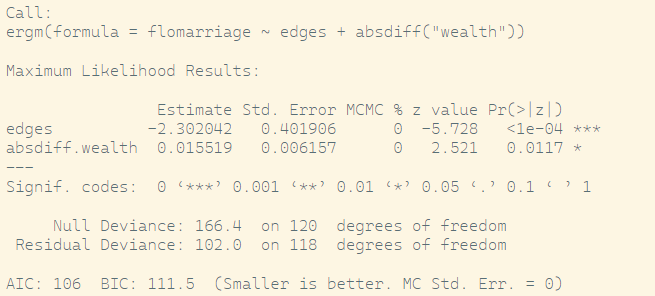
This is the baseline log-odds of a tie between two nodes, assuming their wealth is equal.
Translating to probability:
\[ \text{logit}^{-1}(-2.302) \approx \texttt{plogis(-2.302)} \approx 0.091 \]
→ So, when wealth difference is 0, there’s about a 9.1% chance of a tie.
Coefficient wealth difference:
This means for each unit increase in the absolute difference of wealth between two families, the log-odds of a tie increases by 0.0155.
This is counterintuitive — we would normally expect that greater wealth differences decrease tie probability. But here, ties are more likely as the difference grows.
→ Interpretation: Wealth difference may be associated with strategic marriages between wealthy and less wealthy families (e.g., alliances).
plogis(-2.302 + 0.0155*5)data("faux.mesa.high")
mesa=faux.mesa.high
mesa
fauxmodel.01=ergm(mesa ~edges + nodecov('Grade'))
summary(fauxmodel.01)
fauxmodel.02=ergm(mesa ~edges + nodefactor('Grade'))
summary(fauxmodel.02)nodematch: Uniform homophily and differential homophily
uniform homophily(diff=FALSE), adds one network statistic to the model, which counts the number of edges (i,j) for which attrname(i)==attrname(j).
differential homophily(diff=TRUE), p(#of unique values of the attrname attribute) network statistics are added to the model.
The \(k\)th such statistic counts the number of edges \((i,j)\) for which attrname(i) == attrname(j) == value(k), where value(k) is the \(k\)th smallest unique value of the attrname attribute.
When multiple attribute names are given, the statistic counts only ties for which all of the attributes match.
fauxmodel.03 <- ergm(mesa ~edges + nodematch('Grade',diff=F) )
summary(fauxmodel.03)–> Nodes that share the same attribute are more likely to form a tie. –> Indicates homophily.
fauxmodel.05 <- ergm(mesa ~edges + nodematch('Grade',diff=F)+ nodematch('Race',diff=T) )
summary(fauxmodel.05)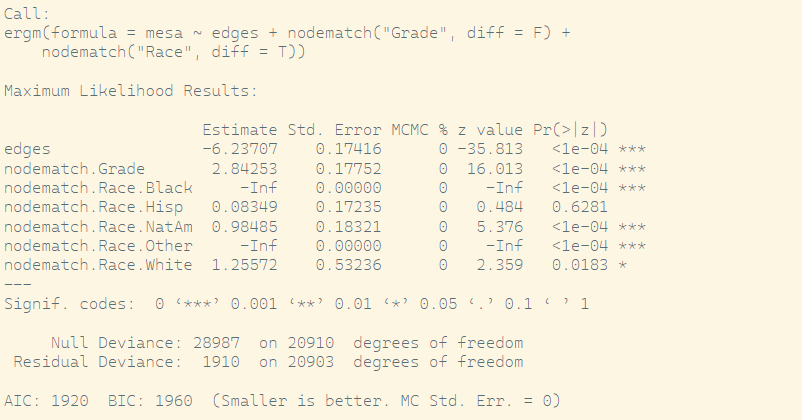
We can use models to similate other networks, maintaining the characteristics defined in the model.
flomodel.04.sim <- simulate(flomodel.04, nsim=10,seed = 1)
summary(flomodel.04.sim)Exercise:
Use the following code to load the karate network from the ìgraphdata package as an object of the network class.
net <- asNetwork(karate)Use ergms to answer these questions and interpret the results.
net %v% "faction" <- V(karate)$Faction
model <- ergm(net ~ edges + nodematch("faction"))
summary(model)model <- ergm(net ~ edges + triangle)
# probably overfitted due to the small network
model <- ergm(net ~ edges + gwesp(0.5, fixed = TRUE))
summary(model)We sadly do not have enough time to delve into these interesting analysis tools in the scope of this seminar but I still want to include them for completeness.
Stochastic Actor-Oriented Models (SAOMs) (Snijders, Van De Bunt, and Steglich 2010) are designed to capture the dynamic evolution of social networks by modeling the decisions and actions of individual actors over time. Unlike static network models, SAOMs incorporate an action-theoretic perspective, emphasizing that network changes result from intentional choices made by actors who seek to optimize their social positions according to certain preferences and constraints. This micro-level focus allows SAOMs to simulate how individual behavior drives the gradual transformation of the network structure, making them particularly well suited for analyzing longitudinal network data.
If you want to have a first look yourself: https://de.slideshare.net/slideshow/22-an-introduction-to-stochastic-actororiented-models-saom-or-siena/175668810 and https://www.stats.ox.ac.uk/~snijders/siena/IntroSAOM_h.pdf here are a straightforward introductions.
To sum things up on our knowledge on social network analysis and in order to get inspired on what we actually can do with these tools now, that we have learned so much, I have collected some case studies from the literature and some insights that they provide us with: Lets start with one, that we have already looked at today:
name=flomarriage %v% 'vertex.names'
plot(flomarriage,
vertex.cex=wealth/25,
main="Florentine marriage by wealth",
cex.main=0.8,
label = name,
vertex.col="lavender")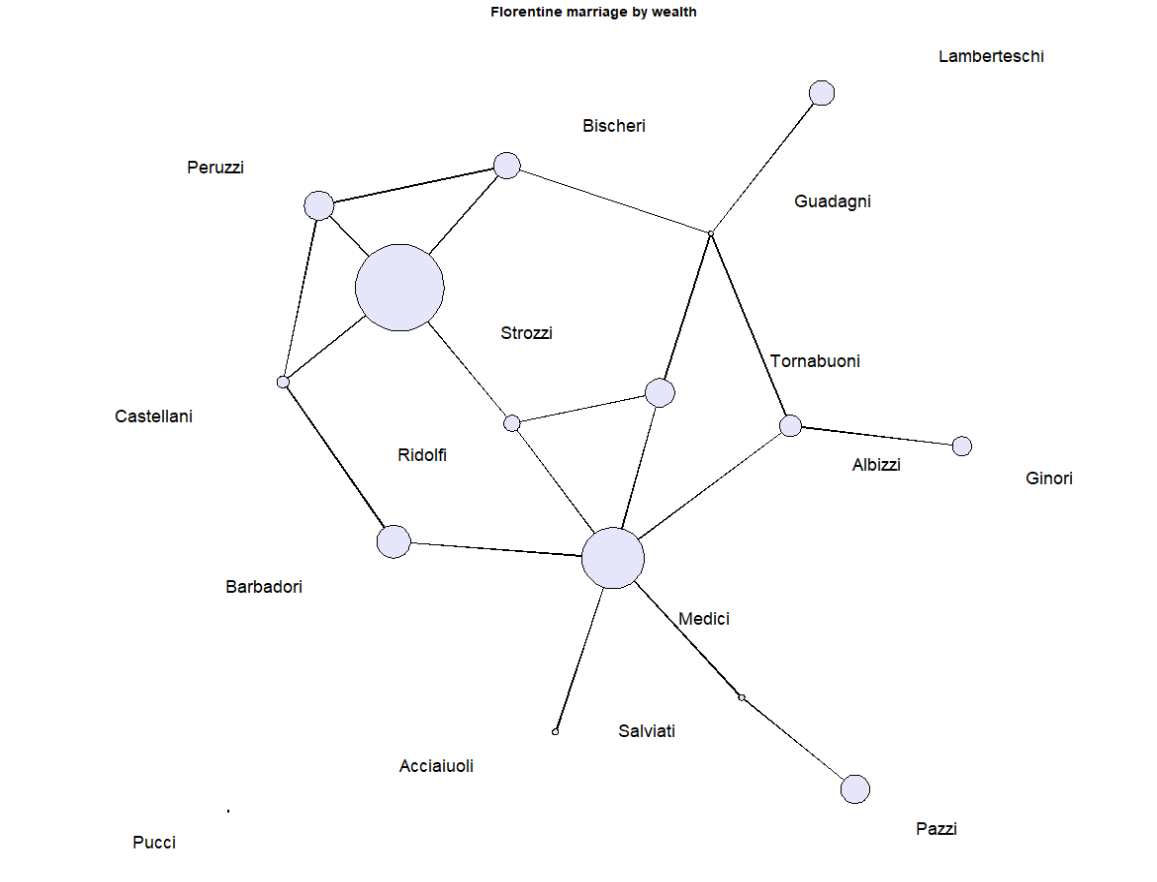
The Florentine marriage network offers a compelling demonstration of how network structure can reveal the foundations of social and political power. Although the Medici family began with relatively modest wealth and political influence, Cosimo de’ Medici strategically leveraged intermarriage ties, economic relationships, and political patronage to consolidate power. His actions positioned the Medici as central brokers within Florence’s elite social network.
While other families like the Strozzi possessed greater wealth and held more political offices, they lacked the Medici’s structural advantage. A simple count of marriage ties shows the Medici ahead—but only marginally. However, a deeper look using betweenness centrality reveals their unique position: the Medici were on over half of all shortest paths connecting other families in the network, with a betweenness score of 0.522. In contrast, the Strozzi scored just 0.103, and the next most central family, the Guadagni, scored 0.255.
This measure reflects the Medici’s pivotal role in brokering connections across elite families. For example, the Medici connected the Barbadori and Guadagni via multiple shortest paths, acting as a key intermediary. Such centrality enabled them to influence communication, marriage arrangements, business alliances, and political decisions.
These findings show how network structure provides critical insight beyond wealth or formal political power. It demonstrates that:
As Padgett and Ansell note, Medician control emerged not from dominance in wealth or titles, but from bridging divides among rival families — something only the Medici managed to achieve. This suggests that elite social networks were both instruments and outcomes of intentional strategy.
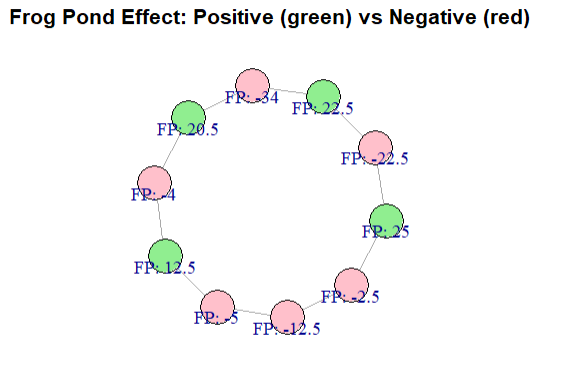
The Frog Pond Effect describes how individuals assess their own abilities not in absolute terms, but relative to those around them. In other words, whether someone feels successful or competent depends heavily on the context or “pond” they’re in.
Being a “big frog in a small pond” — for instance, a strong performer in a weak peer group—often leads to higher self-esteem, while being a “small frog in a big pond” can lead to feelings of inadequacy, even if one’s actual performance is the same.
In network terms:
This has important implications:
g <- make_ring(10) %>%
set_vertex_attr("name", value = LETTERS[1:10]) %>%
set_vertex_attr("achievement", value = c(85, 90, 70, 60, 75, 95, 65, 80, 50, 88))
# Function to calculate frog pond effect for each node
frog_pond <- function(graph) {
ego_scores <- numeric(vcount(graph))
for (i in V(graph)) {
neighbors <- neighbors(graph, i)
if (length(neighbors) > 0) {
avg_neighbor <- mean(V(graph)[neighbors]$achievement)
ego_scores[i] <- V(graph)[i]$achievement - avg_neighbor
} else {
ego_scores[i] <- NA # No neighbors
}
}
return(ego_scores)
}
# Calculate effect and add as attribute
V(g)$frogpond <- frog_pond(g)
# Visualize the graph
plot(
g,
vertex.size = 30,
vertex.label = paste0("\nFP: ", round(V(g)$frogpond, 1)),
vertex.color = ifelse(V(g)$frogpond > 0, "lightgreen", "pink"),
main = "Frog Pond Effect: Positive (green) vs Negative (red)"
)
The Friendship Paradox reveals a surprising social network property:
“On average, your friends have more friends than you do.”
This paradox arises due to how degree centrality interacts with the network structure: individuals with more friends are more likely to appear in others’ friend lists, which biases the average.
# Create a small example network
g <- sample_pa(20, p = 0.2, directed = FALSE)
if (is.null(V(g)$name)) {
V(g)$name <- as.character(seq_along(V(g)) - 1) # igraph uses 0-based indexing
}
# Get the degree (number of friends) for each node
degree_values <- igraph::degree(g)
# For each node, compute the average degree of their neighbors
friend_avg_degrees <- sapply(V(g), function(v) {
neighbors_v <- neighbors(g, v)
if (length(neighbors_v) == 0) return(NA)
mean(igraph::degree(g, neighbors_v))
})
# Compare own degree to the average degree of neighbors
comparison_df <- data.frame(
node = V(g)$name,
own_degree = degree_values,
friends_avg_degree = friend_avg_degrees,
paradox = friend_avg_degrees > degree_values
)
# Output summary
print(comparison_df)
# Optional: visualize who experiences the paradox
V(g)$color <- ifelse(friend_avg_degrees > degree_values, "orange", "lightblue")
plot(g, vertex.label = NA, vertex.size = 10, main = "Friendship paradox: Neighbours have higher degree (orange) vs Neighbours have lower degree (blue)")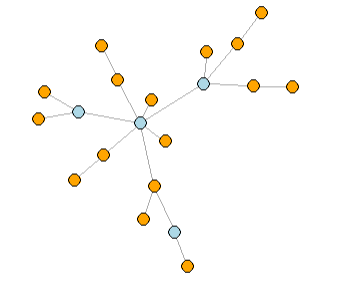
This ist’t just a statistical curiosity but has social consequences:
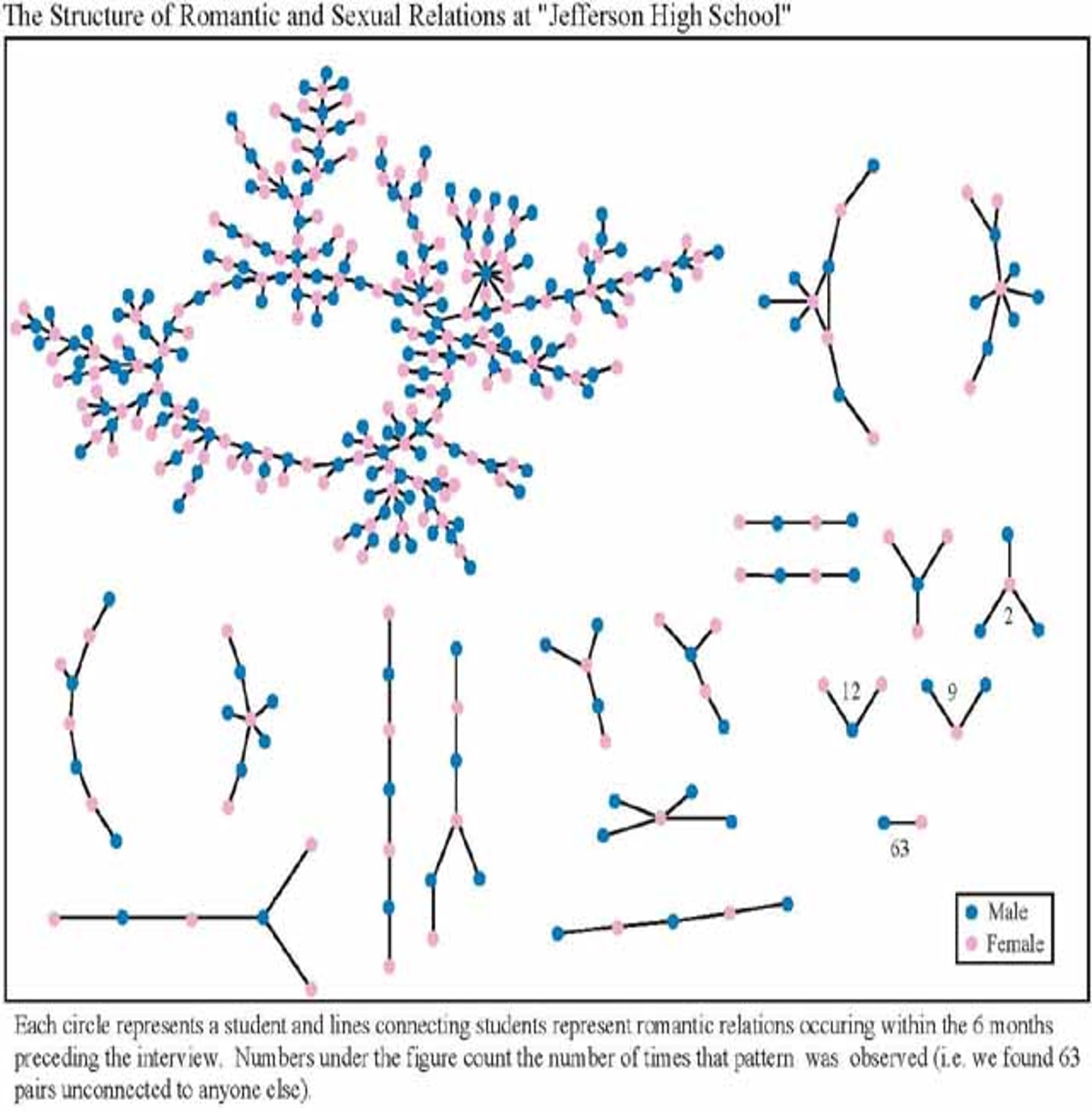
Bearman et al. (2004) asked which structural properties of social networks are relevant for the spread of diseases, as ego-centered network studies reveal little about the broader network structures that facilitate disease transmission. So in 1994 they conducted a study at a U.S. highschool (Jefferson High) with 832 students surveyed on their health status and their sexual and romantic partners in the past 8 months.
The study by Giuseppe Soda, Alessandro Iorio, and Leonardo Rizzo from Bocconi University explores how network science can shed light on the complex social, political, and relational dynamics behind the election of a new Pope. Although the final decision is traditionally attributed to divine inspiration, the researchers demonstrate that the structure of relationships within the College of Cardinals plays a crucial role in shaping consensus and influence.
Behind the closed doors of the Sistine Chapel, the papal election resembles the selection processes found in other organizational contexts—such as presidential elections or CEO appointments—yet it remains deeply embedded in ancient traditions and rituals. By mapping the Vatican as a relational ecosystem, the study identifies key factors that determine which cardinals are more likely to emerge as leading candidates, or papabili.
The researchers constructed a multi-layered network based on:
These layers combined give a systemic map of the College of Cardinals, capturing formal and informal ties alike.
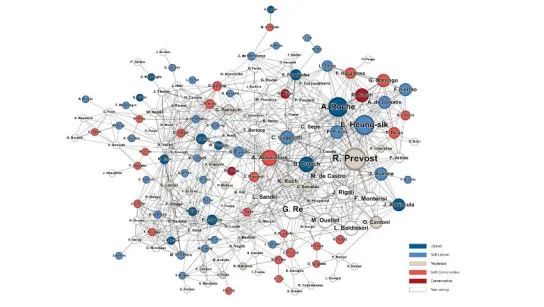
The study identifies three main criteria that increase a cardinal’s prominence in the network:
An additional factor is age, adjusted based on historical papal election trends favoring candidates of moderate age.
Top Status: Robert Prevost (US), Lazzaro You Heung-sik (South Korea), Arthur Roche (UK), Jean-Marc Aveline (France), Claudio Gugerotti (Italy) - Top Information Controllers: Anders Arborelius (Sweden), Pietro Parolin (Italy), Víctor Fernández (Argentina), Gérald Lacroix (Canada), Joseph Tobin (USA) - Top Coalition Builders: Luis Antonio Tagle (Philippines), Ángel Fernández Artime (Spain), Gérald Lacroix (Canada), Fridolin Besungu (Congo), Sérgio da Rocha (Brazil)
The network shows a strong presence of “soft liberal” cardinals and an increasingly global geographical spread, especially with growing roles for Asia and Africa.
It underscores several important insights for network theory:
The study investigates whether happiness spreads through social networks and whether distinct clusters of happy and unhappy individuals form within these networks. Previous research has focused on the role of socioeconomic and genetic factors in determining happiness, but this research takes a relational perspective, exploring how interpersonal connections influence emotional well-being over time.
Using a longitudinal dataset from the Framingham Heart Study, which tracked 4,739 individuals in Massachusetts between 1983 and 2003, the researchers applied social network analysis methods to explore the contagiousness of happiness. Happiness was measured using a validated four-item scale, providing a reliable metric of emotional well-being.
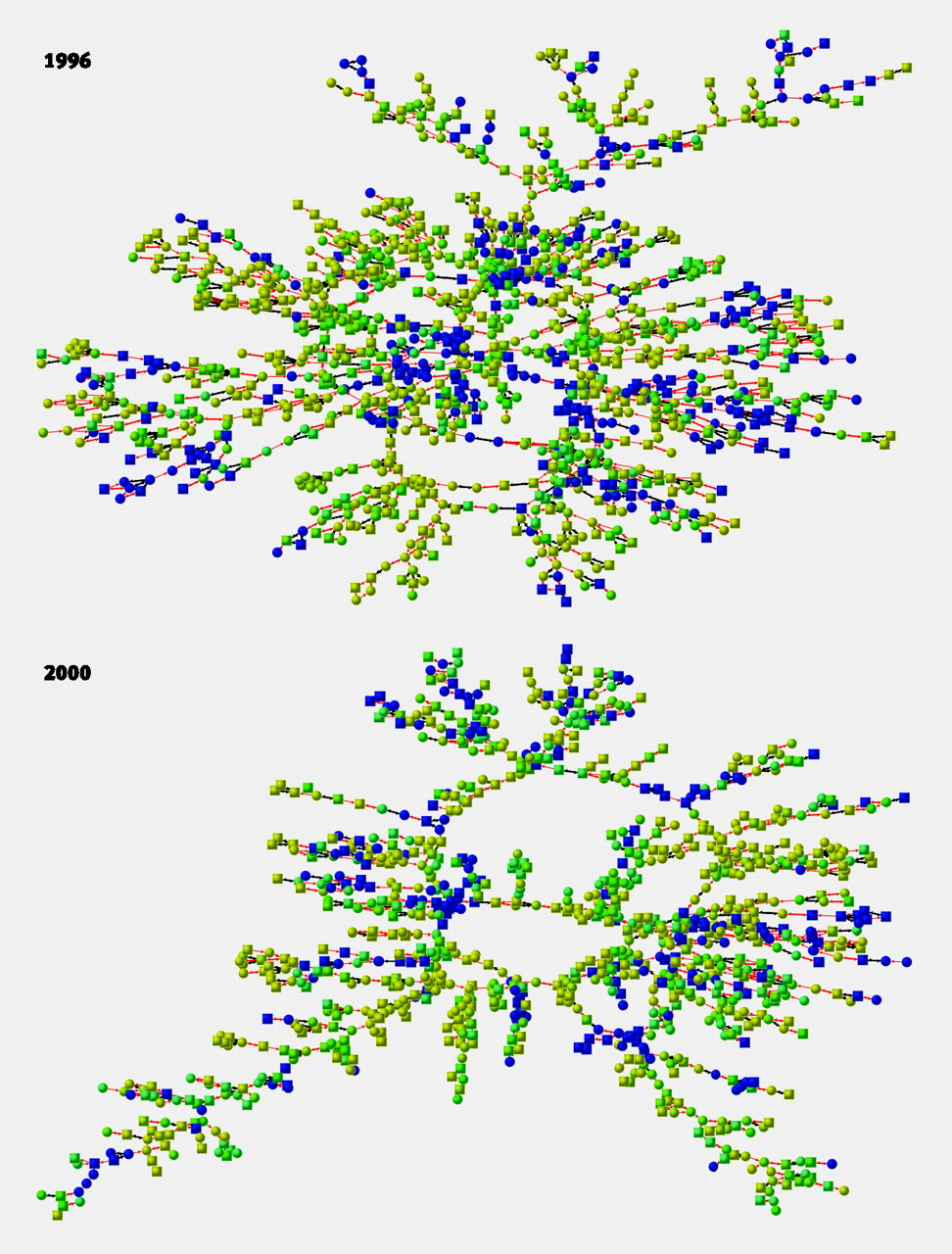
The key findings were:
With implications for sociology:
In my master’s thesis, I conduct a descriptive study on opinion homophily on Twitter. The motivation behind this research is that strong homophily — the tendency for people to connect with others who share similar beliefs — can lead to so called echo chambers and disrupt the broader societal discourse.
So I had a descriptive look following the question: To what extent do people connect (and disconnect) on Twitter based on similar opinions and convictions?
A friend of mine and I collected data (in a different seminar) on tweets on Twitter related to the hashtag #FridaysForFuture (e.g. Tweets, Account ID and Follower/Followee information on all tweets posted in the week between December 4th and December 10th 2019)
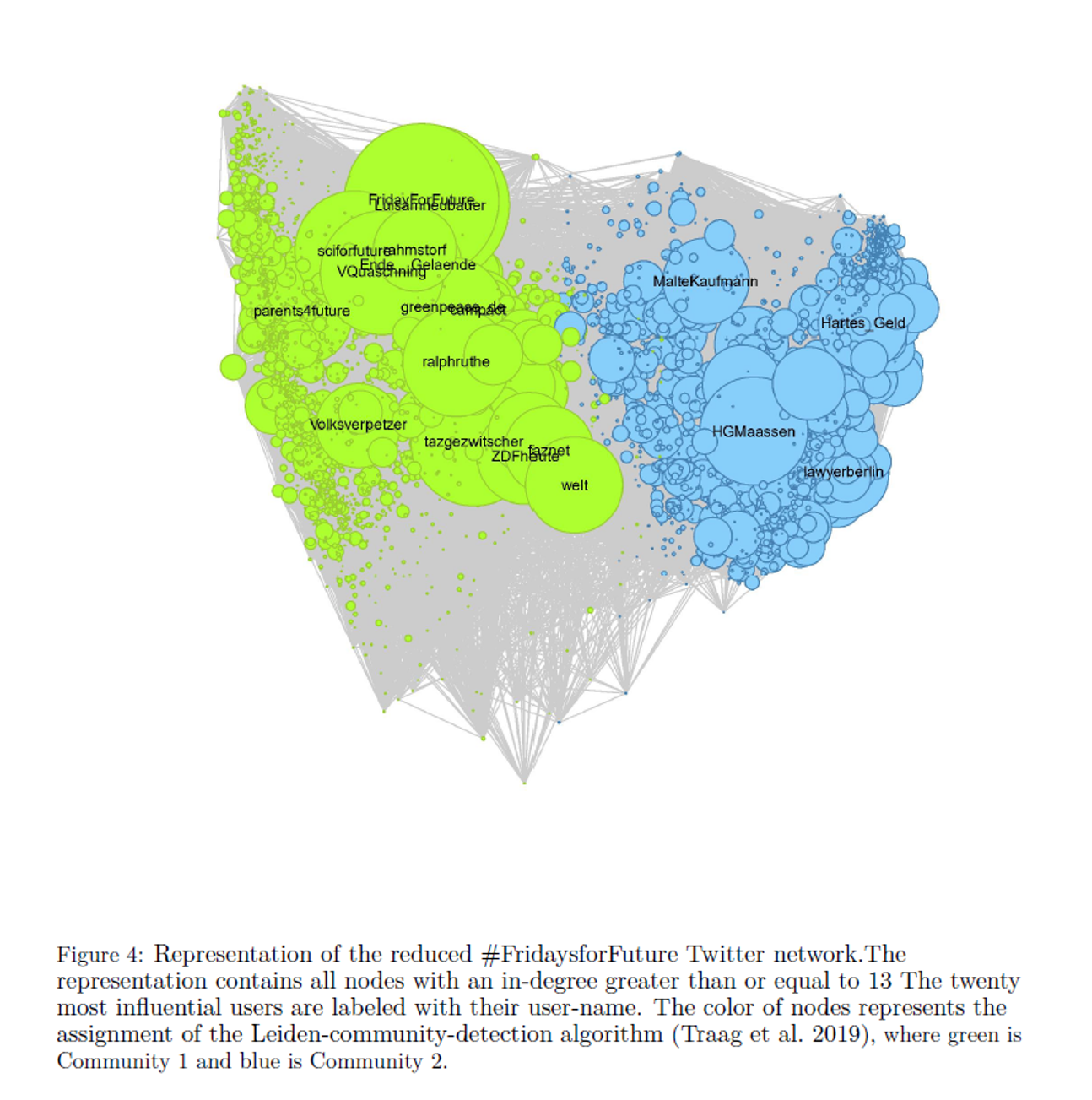
Descriptive comparison of communities:
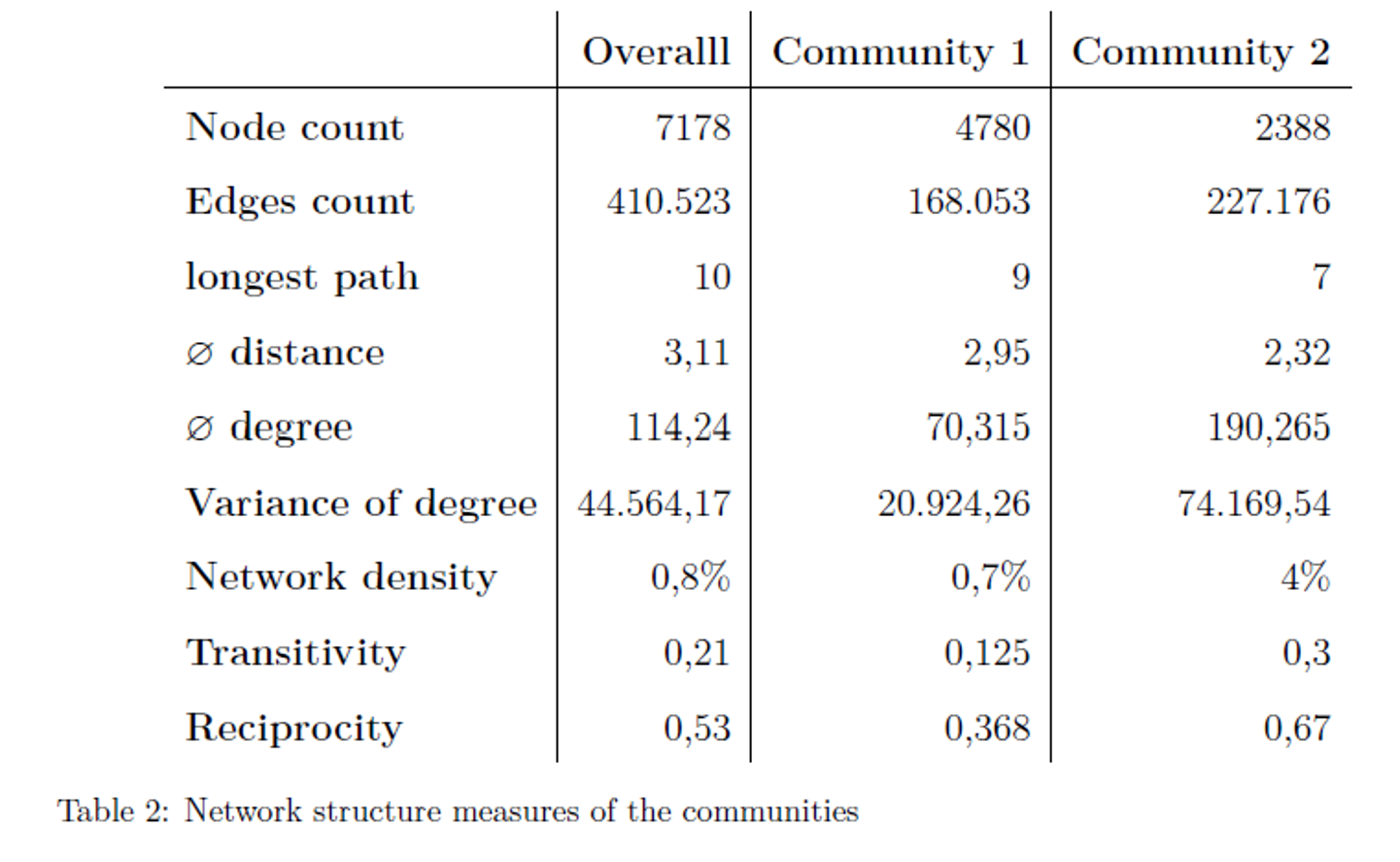
 I then compared the content of the tweets by analyzing frequencies, emojis, and sentiment to determine whether the discourse differed significantly within each cluster. To be fair, today I wouldn’t use these same methods - which is fair, considering there were less chances to learn CSS methods when I studied 😅
Including a triangle term can lead to overfitting in small networks, so it might generally better to use the gwesp() term instead. This term captures triadic closure in a more stable way by applying a geometrically weighted decay to the count of shared partners for each edge.↩︎
The official paper is not yet published↩︎